From the Pacific to the Atlantic – The Highlight of Our Journey!
Well, here we are! The day we’ve been waiting for since we first booked this cruise! Today, we’re experiencing one of the greatest engineering marvels in the world — the Panama Canal!
Our journey takes us from the Pacific Ocean to the Atlantic Ocean, crossing the Isthmus of Panama through a remarkable system of locks, lakes, and channels that forever changed the way ships travel around the world.
Before the Panama Canal opened in 1914, ships traveling between the Atlantic and Pacific Oceans had to make the long and often dangerous journey around Cape Horn at the southern tip of South America. The canal changed all that, shortening the trip by thousands of miles and revolutionizing international shipping.
Construction of the canal was an enormous undertaking. The French first attempted it in the 1880s but were defeated by engineering challenges, tropical diseases, and financial difficulties. The United States eventually completed the project, and the canal officially opened on August 15, 1914. In 1999, control of the canal was transferred to Panama.
So, how does this incredible canal actually work?
Contrary to what some might think, the canal isn’t simply a waterway cut straight through Panama at sea level. Instead, it’s an ingenious system of locks that lifts ships approximately 85 feet above sea level to Gatun Lake, a massive artificial lake in the middle of the country, before lowering them back down to the ocean on the other side.
Think of the locks as giant water elevators for ships! Enormous gates open and close while millions of gallons of water flow in and out of the chambers, raising or lowering vessels without the use of pumps in the original locks. It’s absolutely fascinating!
And here’s something particularly interesting: Traveling from the Pacific to the Atlantic through the Panama Canal actually takes us in a generally northwest direction! That’s because of the unusual shape and geography of Panama.
In 2016, the canal underwent another historic transformation with the opening of its expanded locks, allowing much larger ships, including our magnificent Star Princess, to make the crossing. These newer locks use water-saving basins that recycle a significant portion of the water used during each transit.
The entire canal stretches approximately 50 miles, and a complete transit generally takes 8 to 10 hours, sometimes longer depending on traffic and scheduling.
As we make our way through this incredible passage, we’re surrounded by lush tropical scenery, passing commercial vessels from around the world and watching the remarkable precision involved in guiding enormous ships through the locks.
It’s hard to imagine that more than a century ago, workers carved this passage through dense jungle and mountains with the equipment available at the time. Thousands of workers lost their lives during the French and American construction efforts, making this achievement not only an engineering triumph but also a testament to tremendous human
sacrifice.
For us, this is so much more than another day aboard a cruise ship. It’s the reason we chose this particular voyage — the opportunity to experience a piece of history firsthand!
After days of enjoying the beautiful Pacific Ocean, we’re finally making our way toward the Caribbean Sea and the Atlantic side of the Americas.
 What an extraordinary experience, and certainly one we’ll remember for years to come!
From one ocean to another, with a little help from some very BIG locks! 🚢🌎⚓
Stay tuned for more adventures as our journey continues!
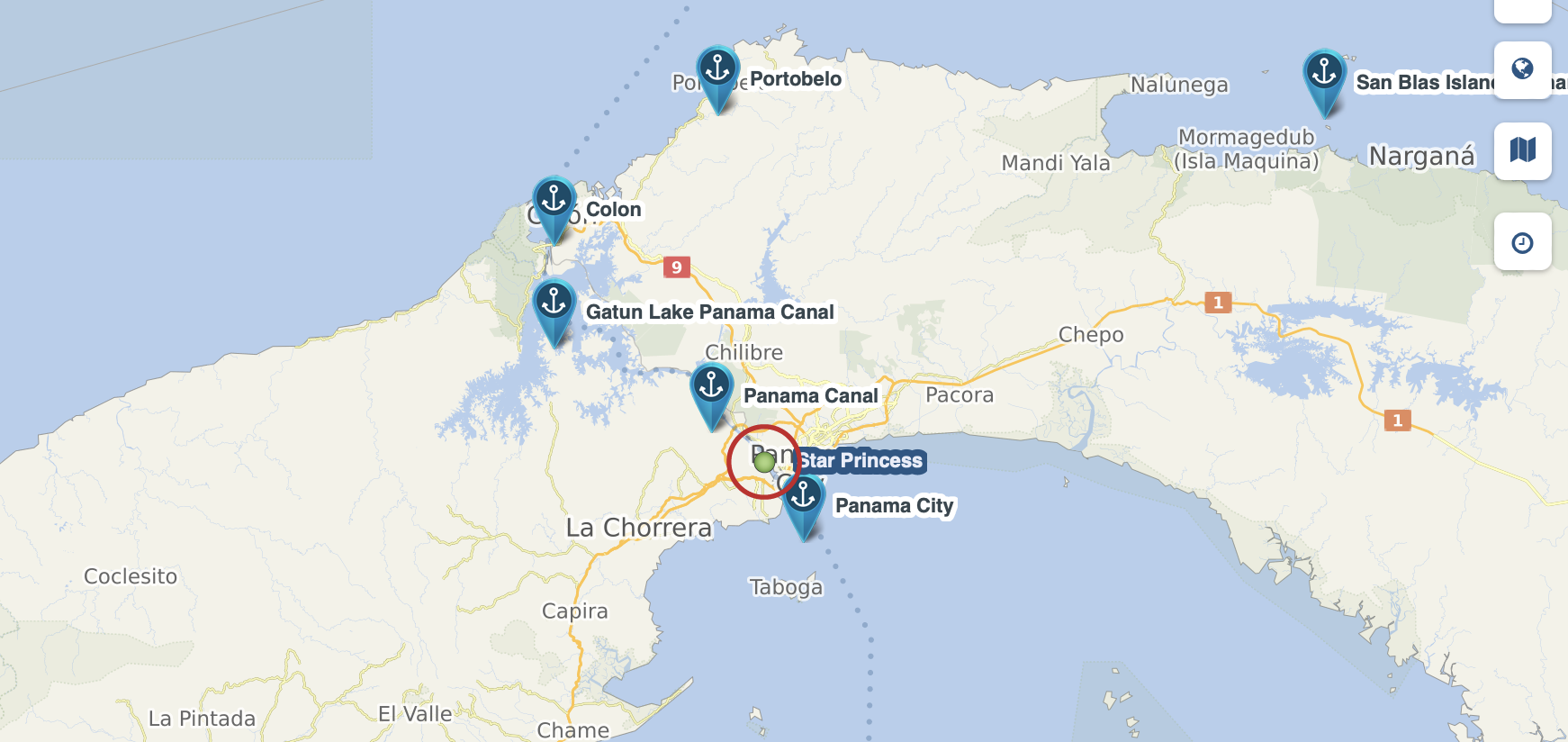
The map shows our exact present position.